
Once it's gone.
Then it's really here to stay.

I think if you asked me to name some of my fondest relationships, my mind would go to people that are now gone. Either from this world or from my life. There is a certain realistic, present tire, that we seem to forget about once people are out of our lives. We romanticize them to be a little more perfect than they might have been—good memories are the most obsequious form of flattery.
There’s a quote from “Where The Dead Wait”, a fun horror novel about arctic expeditions, that’s been sifting it’s way through my thoughts recently. I have perhaps been contorting it into interpretations that weren’t really intended by the author, but they have been influential thoughts nonetheless.
It is I think, intended to talk about how the past can restrict us, causing us to fear:
“The past had its claws around his heart.“1
Recently, its meant to me a sort of implied bias to the events of the past—the claws representing the idealistic hold I have on experiences once had, now only memories past.
It’s easy to remember it as something far more ideal than it really was, because in memory, we are forced to form a more picturesque image, one without the pains, smells, and other associated pressures on the mind and body. At least, we tend to leave out the negative ones. Summer vacation, even school at an earlier time in life, seems more free and undaunting than it might have been for our younger selves. Previous circumstances might be easy for our current selves to deal with, but we weren’t who we are today.
In some way, the past can become something we chalk up to be more than it was, in a way that has us wasting our life in the dingy corridor of nostalgia, a corridor that loses it’s savor if we have worn out our stay. It’s more enthralling to simply push forward in the present, though certainly more challenging.
There’s another horror novel quote that I think aligns a little more closely with what I’m trying to convey.
“The past had a perfection that the future could never hold.“2
This is true for a couple of reasons, one reason being that there is a sort of structure that a piece of glass has, that even glue can’t fix once it’s shattered. Though things can repair and heal, they won’t necessarily be the same.
Don’t get me wrong, I think a refined person who has been slightly damaged in trial but has overcome it, is a more complete person than an inexperienced one, In-fact, I’ve written an entire article on that point.
However, there is a sort of innocent, lulling perfection that it seems to hold nonetheless, an absence that grows as a void, a fondness that expands, with every passing day.
I’d like to examine a quote from a book I’ve been enjoying, Donna Tartt is a talented author.
“
“Aristotle says in the Poetics,” said Henry, “that objects such as corpses, painful to view in themselves, can become delightful to contemplate in a work of art.” “And I believe Aristotle is correct. After all, what are the scenes in poetry graven on our memories, the ones that we love the most? Precisely these. The murder of Agamemnon and the wrath of Achilles. Dido on the funeral pyre. The daggers of the traitors and Caesar’s blood—remember how Suetonius describes his body being borne away on the litter, with one arm hanging down?”
“3
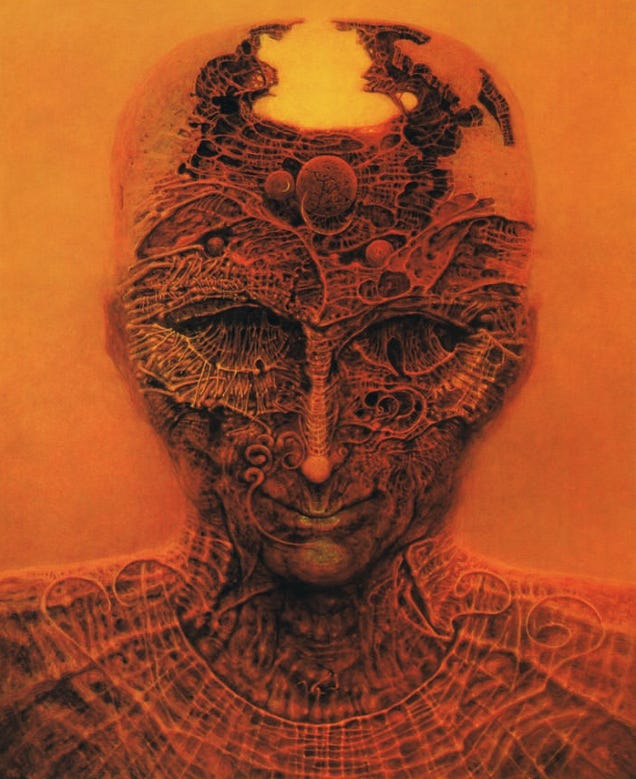
Thanks Zdzislaw for another great picture.
I think it is this incompleteness, this loss of life, that makes something so valuable to us. Unfortunately, I think we also have a proclivity to hone in on things that are disturbing. If your algorithms haven’t taught you that by this point, I think you’re in for more disturbing news. We love watching what we hate.
It also seems to be the binding feature that makes temporary freedom so Salient. As an adult living by myself, I could stay up all night watching movies, playing games, and reading books—a desire I once had, only temporarily enjoyed on occasional sleepovers throughout my childhood.
The fact that I wasn’t entirely in charge of how I spent my time, made the enjoyable excursions of my childhood all the more outstanding. Now, because of responsibilities, and the fact that I have experienced a few sleepless nights before, the awe and wonder I used to hold for such an occasion has lost it’s savor. I’m forced to think of it’s implications for tomorrow, rather than worrying about today.
It’s an unfortunate maturing process, but a necessary one. We learn why we had to hold such free time in such reverence. We needn’t spoil it of it’s novelty, or waste our lives on it either. There is so much more than temporary enjoyment, thought I would hope that is at least takes up a bit of our priority.
In Emma, Emma says to her friend Harriet:
“Which makes his good manners the more valuable. The older a person grows, Harriet, the more important it is that their manners should not be bad; the more glaring and disgusting any loudness, or coarseness, or awkwardness becomes. What is passable in youth is detestable, in later age. Mr. Martin is now awkward and abrupt; what will he be at Mr. Weston’s time of life?“4
To which guideline I have a question—and it’s a classic one: why?
I think I’ve noticed that it’s true, that younger people’s folly is a bit more ‘passable’, but why? Is it just because we expect people with more experience to do better? I think this is part of it, it’s the rational part of it, but I think there’s another justification for it that’s a little more subconscious, that we might all agree with, but aren’t thinking about. At least, we aren’t acknowledging the fact that we are thinking it.
This is that we expect from those who are older than us. Things menial or boring to our oversaturated modern appetite. Grandma, my parents, aunts, and uncles are always the one getting dinner ready on family occasions, it’s just the way things have been. Those tasks we always viewed as chores, are something we expect from them.
Is it because we think they don’t enjoy having free time anymore, that they wrung all the fun out of themselves? While I do think childish play might have dissipated in this way, that there is still a splendor they seek, but often do not get the opportunity to enjoy, being entrenched in responsibility instead.
While one could say that you should enjoy them doing that for you now, rather than to simply look back on it with appreciation, I think there’s an even better alternative.
To take responsibility now, to enjoy your experiences with people, so that your future self doesn’t just miss how things were, but grieves it’s loss. Though it is a pleasing notion to not have to pay any grief, so often coined as the price for love—to live a priceless life would be a tragedy.
So enjoy the now, and revel in it, so that it breaks your heart when it’s gone.
Then, it was here to stay before it ever left.
Where the Dead Wait, Page 210.
The Troop, Page, 367.
The Secret History, ~Page 38-39.
Emma, Page 26.